Technical Guide · 2024-11-28 · 6 min read
How a Synchronous Chip Sealer Works: Complete Technical Breakdown of the Spraying and Spreading Process
Road maintenance and preservation are critical for infrastructure longevity and safety. Among the most effective techniques is chip sealing, a cost-efficient method for extending pavement life. The advent of the synchronous chip sealer has revolutionized this process, enabling simultaneous application of asphalt emulsion and aggregate. This technical guide delves into the intricate working principle of these machines, explaining how they achieve superior results compared to traditional sequential methods.
The Core Principle: Synchronized Application
At its heart, a synchronous chip sealer operates on the principle of applying asphalt binder and aggregate almost simultaneously. This synchronization is key to maximizing the bond between the binder and the aggregate, minimizing binder oxidation, and reducing aggregate loss. Unlike conventional methods where the binder is sprayed and then aggregate is spread in separate passes, the synchronous approach ensures that the aggregate is embedded into the binder while it is still hot and fresh, providing optimal adhesion.
Key Components of a Synchronous Chip Sealer
To achieve this precise synchronization, these machines integrate several sophisticated systems:
* Asphalt Spraying System: Responsible for heating, pumping, and accurately distributing the asphalt emulsion. * Aggregate Spreading System: Manages the storage, conveyance, and uniform distribution of aggregate chips. * Control System: The brain of the operation, coordinating the spraying and spreading systems, often incorporating advanced technologies like radar speed control. * Power Unit: Typically a robust diesel engine providing hydraulic power for all operational functions.
Detailed Breakdown of the Spraying Process
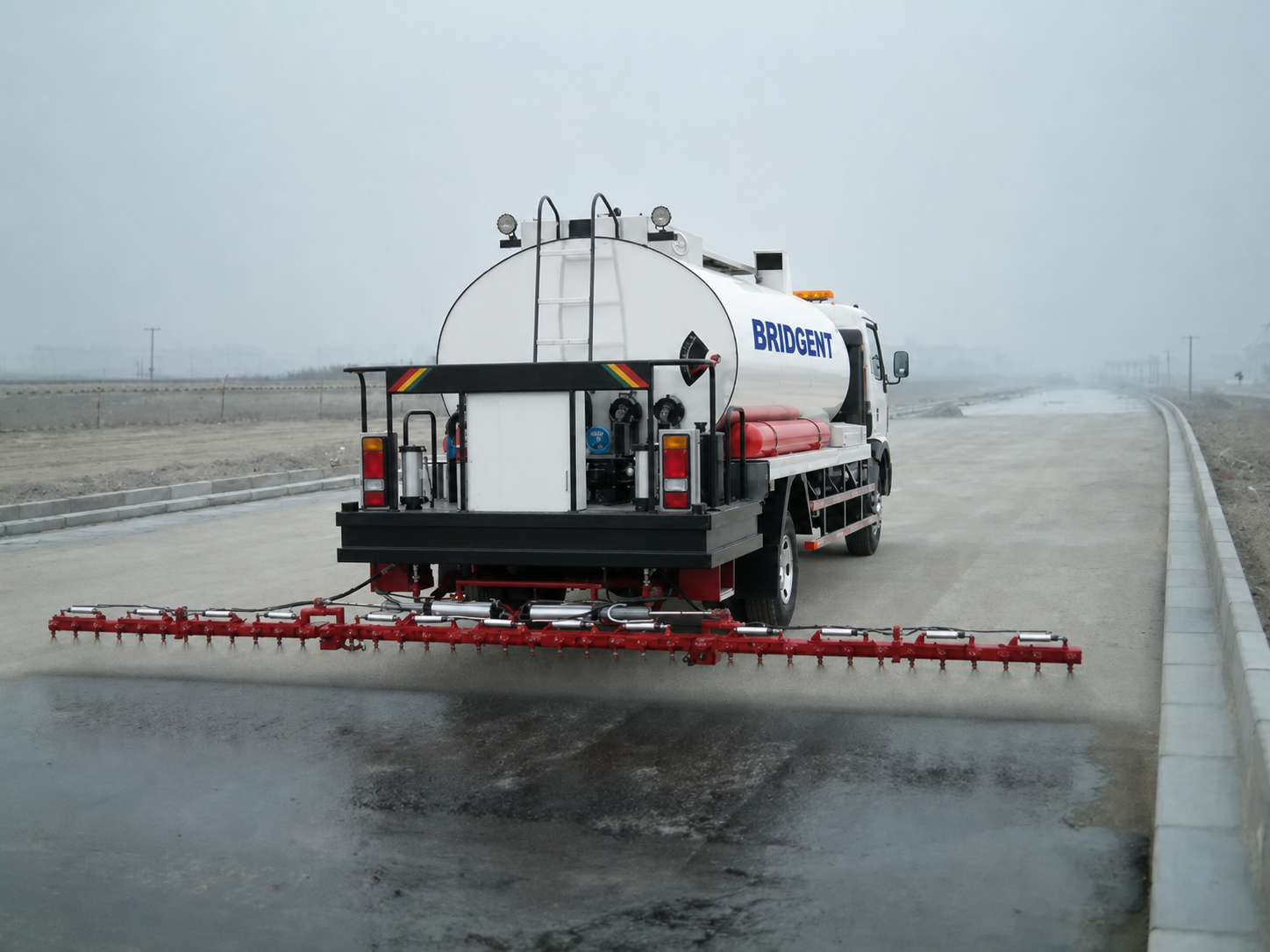
The asphalt spraying system is engineered for precision and consistency. It begins with the storage of asphalt emulsion in insulated tanks, maintained at optimal application temperatures, typically between 60°C and 85°C, depending on the emulsion type.
The Role of the Belgium JOHNSON Pump
A critical component in many high-performance synchronous chip sealers, such as those manufactured by Bridgent Technology, is the Belgium JOHNSON pump. This positive displacement pump is renowned for its reliability and ability to maintain a consistent flow rate regardless of changes in viscosity or pressure. Its precise metering capabilities are essential for ensuring a uniform application rate of the asphalt emulsion across the road surface. The pump draws emulsion from the tanks and delivers it to the spray bar under controlled pressure.
Spray Bar and Nozzle Overlap Patterns
The spray bar, equipped with multiple nozzles, is designed to provide full and even coverage. Nozzles are typically spaced at intervals (e.g., 100-150 mm) and angled to create a specific overlap pattern. A common configuration involves a triple overlap pattern, where each point on the road surface receives emulsion from three different nozzles. This design ensures that any minor blockage in a single nozzle does not result in an unsprayed strip, thus guaranteeing uniform coverage and preventing streaking. The spray pressure and nozzle size are carefully selected to achieve the desired application rate and spray fan characteristics.
Detailed Breakdown of the Spreading Process
Immediately following the asphalt spray, the aggregate spreading system deploys the chips. This rapid sequence is what defines the synchronous process.
Aggregate Conveyance and Distribution
Aggregate chips, typically ranging from 6 mm to 13 mm in size, are stored in a large hopper on the machine. A conveyor belt system, often hydraulically driven, transports the aggregate from the hopper to the spreading unit. The spreading unit itself usually consists of a rotating spreader roll or a series of gates that precisely control the flow of aggregate onto the freshly sprayed binder. The height of the spreading unit above the road surface is adjustable to optimize the aggregate drop and embedment.
Radar Speed Control for Precision
Modern synchronous chip sealers incorporate radar speed control systems to ensure that both the asphalt spray rate and the aggregate spread rate are precisely proportional to the vehicle's ground speed. A radar sensor continuously measures the actual speed of the machine. This data is fed into the control system, which then dynamically adjusts the pump speed for the asphalt emulsion and the conveyor/spreader roll speed for the aggregate. This ensures a consistent application rate (liters per square meter for asphalt, kilograms per square meter for aggregate) regardless of minor fluctuations in driving speed, which is crucial for uniform coverage and material efficiency.
Operational Advantages of Synchronous Application
The synchronized application method offers several significant advantages over traditional sequential chip sealing:
Enhanced Adhesion and Reduced Aggregate Loss
By applying aggregate immediately after the binder, the chips are embedded into the asphalt emulsion while it is still in its most receptive state. This leads to superior adhesion, minimizing aggregate loss due to traffic whip-off. Studies have shown that synchronous application can reduce initial aggregate loss by up to 30% compared to sequential methods.
Improved Binder Penetration and Curing
The rapid embedment of aggregate helps to
Discuss Your Project
Contact Bridgent for equipment specifications and a project-specific quotation.