Technical Guide · 2024-07-30 · 7 min read
Crack sealing is consistently identified by pavement engineers as the single most cost-effective pavement maintenance treatment available. Studies have shown that every dollar spent on crack sealing can save 6–10 dollars in future rehabilitation costs by preventing water infiltration and the accelerated deterioration it causes.
Why Cracks Are So Damaging
Cracks in asphalt pavement are not just cosmetic defects — they are pathways for water to enter the pavement structure. Once water infiltrates through cracks:
- The base and subgrade become saturated and lose strength
- Freeze-thaw cycles cause further cracking and spalling
- Traffic loading on the weakened structure causes rapid deterioration
- Potholes and structural failures develop
A pavement that is crack-sealed before water infiltration can last 5–10 years longer than an identical pavement that is not crack-sealed. The cost of crack sealing is typically USD 0.5–2.0 per meter of crack, while the cost of the rehabilitation it prevents is typically USD 50–200 per square meter.
Types of Pavement Cracks
Transverse Cracks Cracks perpendicular to the road centerline, typically caused by thermal contraction of the asphalt or reflection of joints in the underlying base.
Longitudinal Cracks Cracks parallel to the road centerline, typically caused by pavement fatigue, differential settlement, or reflection of longitudinal joints.
Alligator (Fatigue) Cracking Interconnected cracks forming a pattern resembling alligator skin, caused by structural fatigue under traffic loading.
Block Cracking Large rectangular cracks dividing the pavement into blocks, caused by thermal cycling and asphalt aging.
Crack Sealing vs. Crack Filling
Crack Sealing uses a flexible, rubberized sealant that is applied to working cracks (cracks that open and close with temperature changes). The flexible sealant accommodates the crack movement without failing.
Crack Filling uses a less flexible material to fill non-working cracks (cracks that do not move significantly with temperature changes).
Crack Sealing Process
1. Crack preparation: Clean the crack using a router or saw to create a uniform reservoir for the sealant 2. Air blasting: Remove dust and debris from the crack using compressed air 3. Sealant application: Apply hot-applied rubberized sealant to the crack using a crack sealing machine 4. Blotting: Apply sand or fine aggregate to the sealant surface to prevent tracking
Equipment Selection
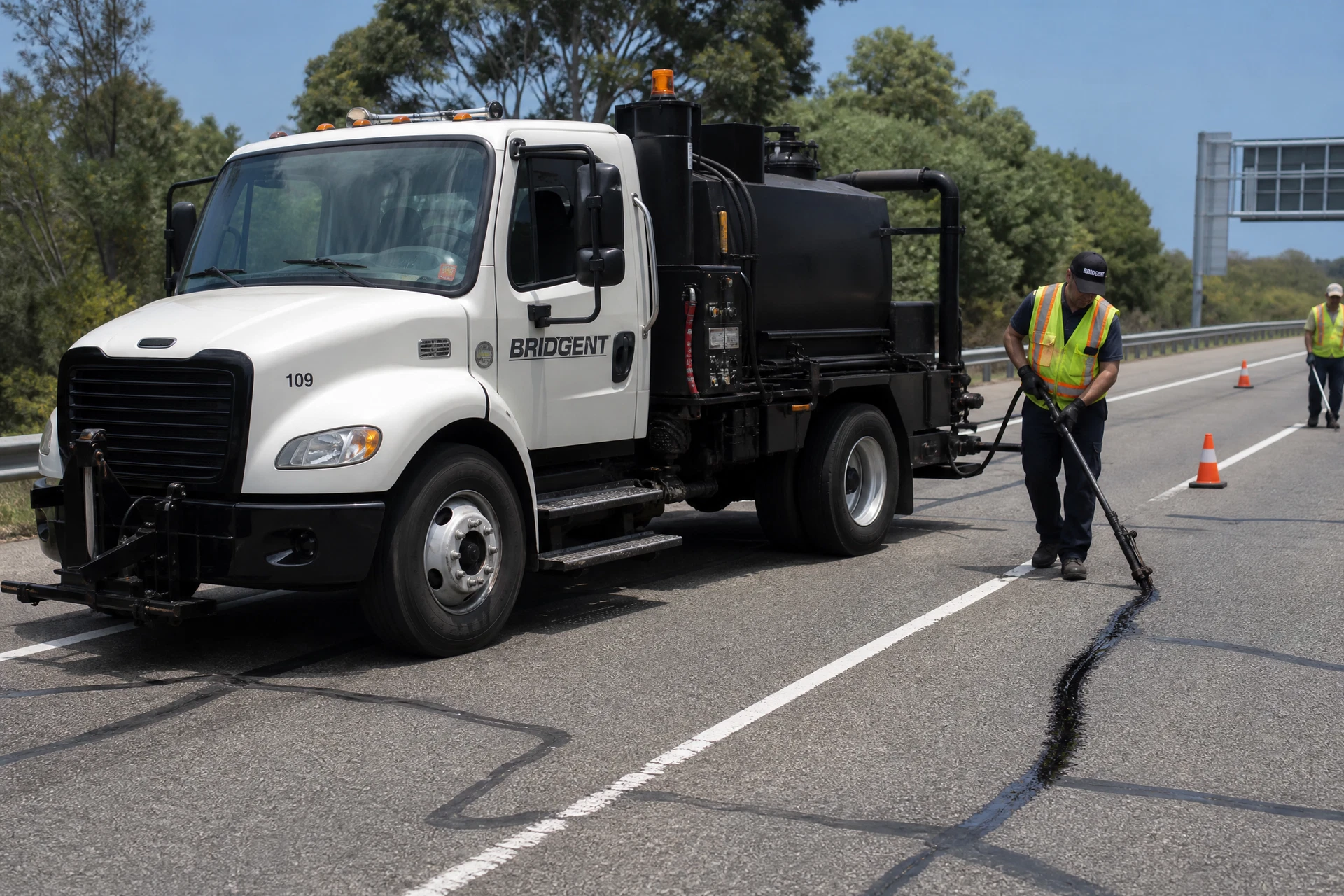
Crack sealing equipment ranges from simple hand-operated wands to sophisticated truck-mounted systems:
Hand-Operated Equipment
- Low capital cost
- Labor-intensive
- Suitable for small quantities
Truck-Mounted Crack Sealing Machines
- Higher capital cost
- More efficient for large quantities
- Automatic temperature control for consistent sealant quality
- Suitable for large-scale crack sealing programs
Key specifications for truck-mounted crack sealing machines:
- Tank capacity: 500–1,000L for extended operations
- Heating system: Automatic temperature control ±5°C
- Application rate: Up to 200 m/hour
- Sealant compatibility: Compatible with all standard hot-applied sealants
Timing of Crack Sealing
Crack sealing is most effective when applied to cracks that are:
- 6–25mm wide (narrower cracks may not be practical to seal; wider cracks may need other treatment)
- Not severely deteriorated (raveled or spalled edges)
- Not alligator cracking (which indicates structural failure)
The optimal time to crack seal is before the crack edges deteriorate and before water infiltration causes base damage — typically when the pavement is 3–7 years old and the first cracks are appearing.
Discuss Your Project
Contact Bridgent for equipment specifications and a project-specific quotation.
Topics
- crack sealing
- pavement crack repair
- road maintenance cost-effectiveness