Technical Guide · 2024-11-02 · 7 min read
Chip sealing is a highly cost-effective preventive maintenance treatment used globally to extend the lifespan of deteriorating pavements, seal microscopic cracks, and restore skid resistance. However, the success of this surface dressing technique relies heavily on one foundational engineering decision: selecting the correct chip seal aggregate size.
When road engineers and procurement managers design a pavement preservation program, the diameter of the stone chip dictates not only the macro-texture and acoustic properties of the finished road but also the required binder application rates and the treatment's overall durability. Incorrect sizing can lead to premature failure mechanisms, such as aggregate shelling (loss of stone) or bleeding (binder flushing to the surface).
This technical guide explores the engineering principles behind aggregate size selection, how to match stone diameter to traffic and pavement conditions, and the critical relationship between aggregate dimensions and binder application.
The Science of Chip Seal Aggregate Size
In surface dressing, the aggregate serves as the primary wear course. It provides the micro- and macro-texture necessary for vehicle traction and protects the underlying waterproof bitumen membrane from traffic abrasion and ultraviolet (UV) degradation.
The physical dimensions of the aggregate, particularly its Average Least Dimension (ALD), are paramount. The ALD represents the average smallest dimension of the aggregate particles, which directly influences the embedment depth into the binder. A properly designed chip seal aims for approximately 60-70% embedment of the aggregate into the asphalt binder. This ensures maximum stone retention while preventing excessive binder exposure, which can lead to flushing and reduced skid resistance.
Standard Aggregate Sizes and Their Applications
Standard aggregate sizes for chip seals typically range from 6mm to 20mm, each suited for different traffic volumes, pavement conditions, and desired surface characteristics. The selection process is a careful balance of engineering principles and practical considerations.
6mm Aggregate
* Characteristics: Smallest common size, provides a fine texture. * Applications: Ideal for low-volume roads, residential streets, and as a top layer in double chip seals. It offers good skid resistance and a relatively smooth ride. * Considerations: Requires a very uniform application of binder due to its small size. Less forgiving of variations in pavement texture.
10mm Aggregate
* Characteristics: A versatile, commonly used size, offering a balance between texture and durability. * Applications: Suitable for moderate traffic volumes, county roads, and as a standard single surface treatment. Provides good aggregate interlock and resistance to traffic wear. * Considerations: A good all-around choice for many chip seal projects, offering a balance of performance and cost-effectiveness.
14mm Aggregate
* Characteristics: Larger aggregate, providing a coarser texture and enhanced durability. * Applications: Recommended for higher traffic volumes, arterial roads, and highways. Offers excellent skid resistance and improved resistance to rutting and heavy vehicle loads. * Considerations: Requires careful attention to binder application rates to ensure proper embedment and prevent aggregate loss. Can be noisier than smaller aggregates.
20mm Aggregate
* Characteristics: The largest common size, used for demanding applications. * Applications: Best suited for very high traffic volumes, heavy commercial vehicle routes, and as a base layer in double chip seals over soft or distressed pavements. Provides maximum aggregate interlock and structural stability. * Considerations: Can lead to higher tire-pavement noise. Requires robust application equipment and precise control of binder to prevent flushing or excessive stone loss.
Matching Aggregate Size to Traffic Volume and Pavement Condition
Selecting the appropriate chip seal aggregate size is not a one-size-fits-all process. Procurement managers and road engineers must evaluate two primary site-specific variables: Annual Average Daily Traffic (AADT) and the hardness of the existing pavement.
Heavy traffic will push the aggregate deeper into the underlying pavement over time. If the existing asphalt is soft (due to high temperatures or excess residual binder), a smaller aggregate will quickly embed too deeply, leading to a flushed, slippery surface. Conversely, if the existing pavement is extremely hard and oxidized, a large aggregate will struggle to achieve initial embedment, increasing the risk of windshield damage from flying stones.
Aggregate Selection Matrix
| Standard Size | Optimal Traffic Volume (AADT) | Existing Pavement Hardness | Primary Application Use Case | | :--- | :--- | :--- | :--- | | 6mm | < 500 vehicles/day | Hard, minor oxidation | Residential streets, top layer of double seal | | 10mm | 500 – 2,000 vehicles/day | Moderate | County roads, standard single surface treatments | | 14mm | 2,000 – 5,000 vehicles/day | Soft to Moderate | High-speed highways, routes with commercial traffic | | 20mm | > 5,000 or Heavy HGV | Very Soft / Flushed | Base layer of double seal, industrial logging routes |
The Relationship Between Aggregate Size and Asphalt Application Rate
The fundamental rule of surface dressing design is that the asphalt application rate must be directly proportional to the chip seal aggregate size. If you use a larger stone, you must apply more binder to achieve the necessary 70% embedment depth.
Using the McLeod design method or similar volumetric calculations, engineers determine the exact liters per square meter (or gallons per square yard) required. If a 14mm aggregate is placed over a binder rate designed for a 10mm aggregate, the stones will lack sufficient capillary adhesion and will be swept off the road by traffic.
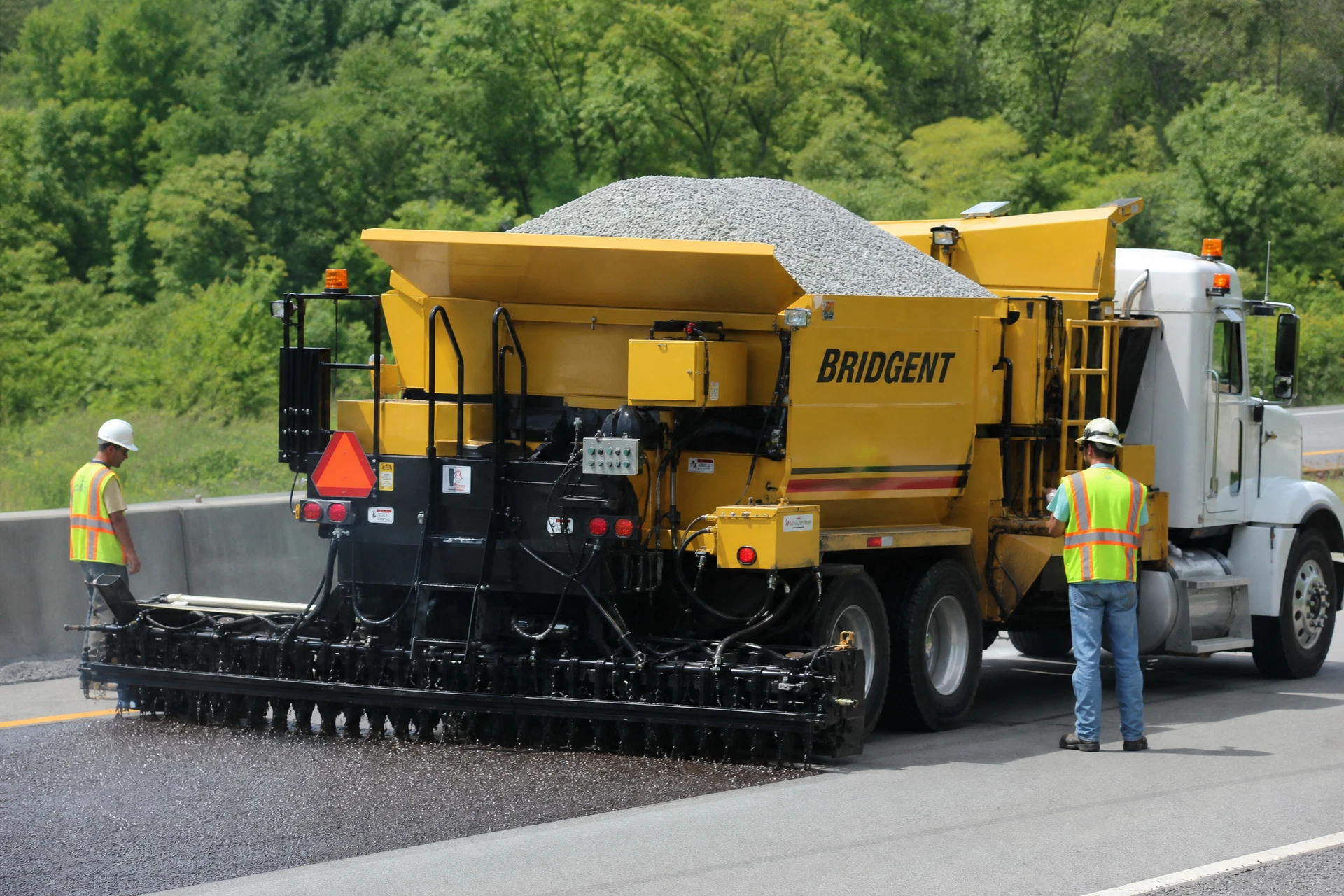
Achieving this precise balance in the field requires highly accurate equipment. Modern synchronous chip sealers, such as those engineered by Bridgent Technology, are essential for executing these complex designs. By utilizing computer-controlled spraying and spreading mechanisms, Bridgent equipment ensures that the binder application rate perfectly matches the physical dimensions of the chosen aggregate, eliminating the risk of uneven embedment or material waste.
Pre-Coating Requirements for Maximum Adhesion
Regardless of the chosen chip seal aggregate size, dust is the primary enemy of asphalt adhesion. Even a microscopic layer of dust on the stone can prevent the bituminous binder from bonding to the aggregate surface, leading to catastrophic raveling shortly after the road is opened to traffic.
To mitigate this risk, industry best practices dictate that aggregates—particularly the larger 14mm and 20mm sizes—should be pre-coated. Pre-coating involves tumbling the raw stone with a very light application of bitumen (typically 0.5% to 1.0% by weight) or a specialized emulsion before it is transported to the job site.
Pre-coating achieves three critical objectives: 1. It neutralizes surface dust. 2. It breaks the surface tension of the stone, allowing the sprayed binder to wick up the sides of the aggregate more rapidly. 3. It darkens the stone, which helps the road surface absorb solar heat, accelerating the curing process of the underlying emulsion.
Handling pre-coated aggregate requires robust machinery, as the tacky stones can occasionally bridge or clump in standard hoppers. High-performance aggregate spreaders, like those manufactured by Bridgent, feature optimized hopper geometries and advanced feed roller systems designed specifically to dispense pre-coated materials smoothly, ensuring a uniform spread rate across the entire width of the pavement.
Key Takeaways
* Size Dictates Performance: The chosen chip seal aggregate size directly controls the macro-texture, skid resistance, and noise levels of the finished road surface. * Context is Crucial: Always match the aggregate diameter to the specific traffic volume (AADT) and the relative hardness of the existing pavement. Use larger stones (14mm, 20mm) for heavy traffic and softer pavements, and smaller stones (6mm, 10mm) for lower traffic and harder pavements. * Binder Rates Must Adapt: The asphalt binder application rate must be mathematically calibrated to the Average Least Dimension (ALD) of the aggregate to ensure 60-70% embedment. * Pre-Coat for Durability: Pre-coating aggregates, especially larger diameters, is a highly recommended practice to eliminate dust and guarantee rapid, permanent adhesion between the stone and the binder. * Equipment Matters: Utilizing precision machinery ensures that the carefully calculated ratios of binder and aggregate are executed flawlessly on the job site.
Discuss Your Project
Contact Bridgent for equipment specifications and a project-specific quotation.