Industry Insight · 2024-07-15 · 9 min read
Africa faces a massive road maintenance challenge. The continent has over 2 million kilometers of paved roads, but many road authorities have maintenance budgets that cover only a fraction of the network's needs. In this context, selecting the most cost-effective maintenance strategy is not just a technical decision — it is a matter of economic survival for road networks.
The African Road Maintenance Challenge
African road authorities face a unique combination of challenges:
- Large networks: Many countries have extensive road networks built during development programs
- Limited budgets: Maintenance budgets are often 30–50% of what is needed for adequate maintenance
- Harsh conditions: High temperatures, heavy rainfall, and heavy truck traffic accelerate pavement deterioration
- Deferred maintenance: Budget constraints lead to deferred maintenance, which accelerates deterioration and increases long-term costs
The result is a vicious cycle: deferred maintenance leads to more rapid deterioration, which requires more expensive rehabilitation when it is eventually addressed, which further strains budgets.
Why Chip Seal is the Answer
Chip seal (surface dressing) offers the best combination of cost-effectiveness, performance, and suitability for African conditions:
Cost: Chip seal costs approximately USD 2–5 per square meter, compared to USD 15–30 for thin asphalt overlay and USD 50–100 for full reconstruction. For the same budget, a road authority can treat 5–10 times more road with chip seal than with overlay.
Performance in African Conditions: Chip seal is particularly well-suited to African conditions:
- Excellent performance in high-temperature environments
- Good resistance to the heavy truck traffic common on African roads
- Effective at sealing surface cracks before they allow water infiltration
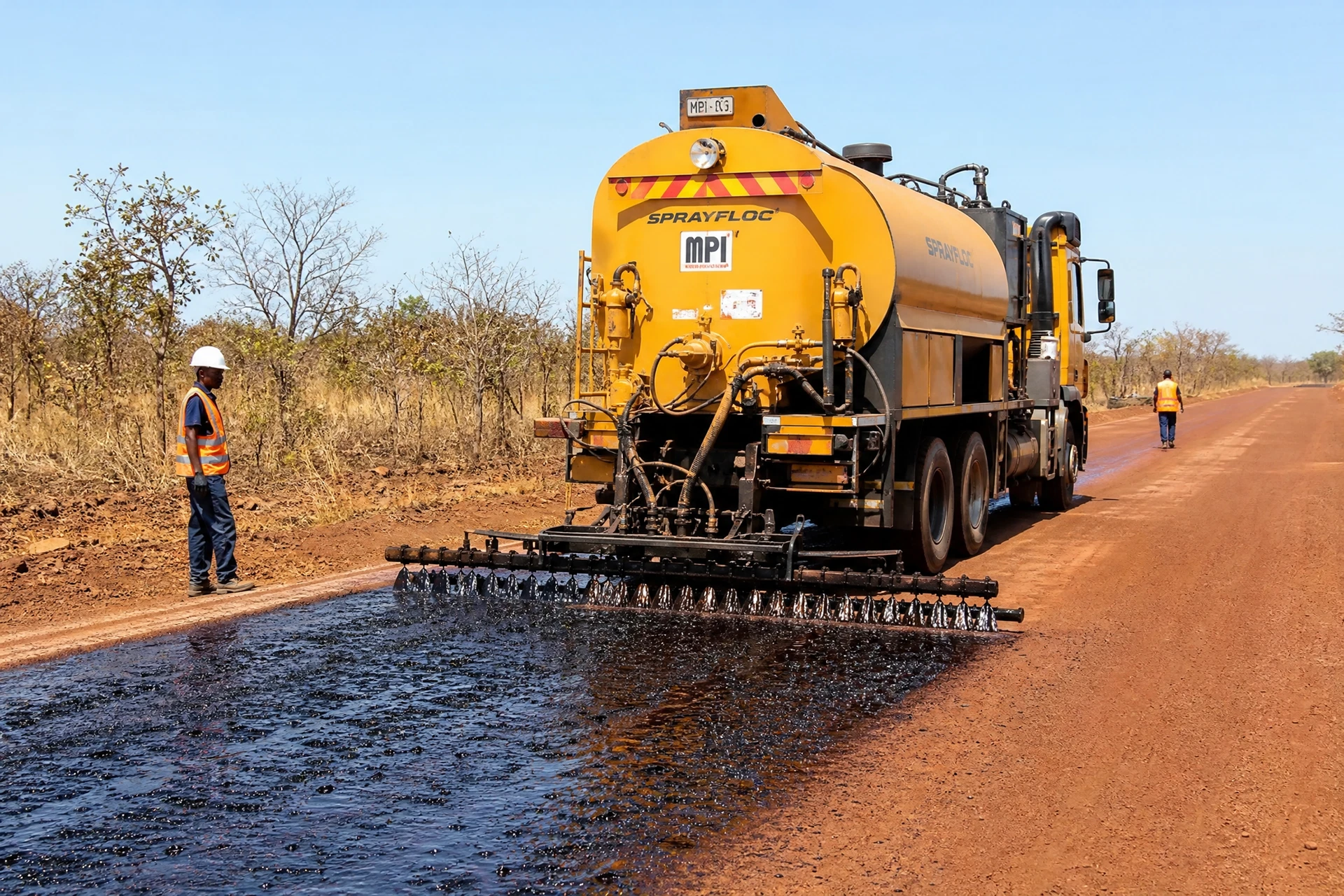
- Can be applied with relatively simple equipment that is easy to maintain
Timing: The key to chip seal effectiveness is applying it at the right time — before the pavement deteriorates to the point where more expensive treatments are needed. Chip seal applied to a pavement with a PCI of 70–85 can extend its service life by 7–10 years. The same pavement, if allowed to deteriorate to a PCI of 50, would require overlay or reconstruction.
Successful Chip Seal Programs in Africa
Several African countries have implemented successful chip seal maintenance programs:
Kenya: The Kenya National Highways Authority (KeNHA) has used chip seal extensively on its national road network, achieving significant cost savings compared to overlay-based maintenance strategies.
South Africa: South Africa has a long tradition of chip seal (surface dressing) maintenance, with well-developed specifications and quality control procedures that have been adopted by other African countries.
Ethiopia: Ethiopia's road maintenance program has increasingly relied on chip seal to maintain its rapidly expanding road network within budget constraints.
Equipment Recommendations for Africa
For African road maintenance programs, we recommend:
- Synchronous chip sealers: For better aggregate retention and longer service life
- 8,500L asphalt tank: For adequate capacity without excessive weight
- SINOTRUK HOWO chassis: For reliability and spare parts availability in Africa
- Comprehensive spare parts stock: Critical for remote operations
Conclusion
Chip seal is not just a cost-effective maintenance strategy — it is the strategy that makes it possible for African road authorities to maintain their networks within realistic budget constraints. With the right equipment, proper application techniques, and good timing, chip seal can keep African roads in serviceable condition and prevent the catastrophic deterioration that makes rehabilitation so expensive.
Discuss Your Project
Contact Bridgent for equipment specifications and a project-specific quotation.
Topics
- Africa road maintenance
- chip seal Africa
- surface dressing
- road maintenance budget