Application Guide · 2024-05-05 · 7 min read
The Challenge of Dust on Unpaved Roads
Unpaved roads, common in rural, industrial, and construction settings, are vital for connectivity but pose significant challenges, primarily due to dust generation. Dust not only reduces visibility, leading to safety hazards, but also contributes to respiratory health issues for nearby communities and workers. Furthermore, dust causes material loss from the road surface, increasing maintenance frequency and costs, and can negatively impact agricultural yields and environmental quality. Traditional dust control methods, such as watering, offer only temporary relief and require frequent reapplication, making them unsustainable and costly in the long run.
Understanding Bitumen Emulsion for Dust Suppression
Bitumen emulsion presents a highly effective and environmentally conscious solution for dust suppression on unpaved roads. It is a stable dispersion of bitumen in water, achieved through a chemical emulsification process. Unlike hot-applied bitumen, emulsions can be applied at ambient temperatures, simplifying application and reducing energy consumption. For dust suppression, the key is to use a diluted emulsion that penetrates the road surface, binding loose particles together to form a cohesive, dust-free layer.
The Science Behind Dust Control with Bitumen Emulsion
When diluted bitumen emulsion is applied to an unpaved road, the water evaporates, leaving behind a thin film of bitumen that coats and binds the soil and aggregate particles. This binding action increases the cohesion of the surface material, preventing fine particles from becoming airborne under traffic stress or wind. The result is a stabilized surface that resists dust generation, improves road integrity, and reduces aggregate loss.
Application Method and Equipment
Effective application of bitumen emulsion is crucial for achieving optimal dust suppression. The process typically involves several steps and requires specific equipment.
Required Emulsion Type
For dust suppression, a slow-setting anionic bitumen emulsion is generally recommended. Slow-setting emulsions allow for deeper penetration into the road base before breaking (coalescing), ensuring better binding of particles. Anionic emulsions are negatively charged and work well with positively charged aggregates, which are common in many road materials. It is important to consult with suppliers like Bridgent Technology to ensure the correct emulsion grade and formulation are selected for specific soil types and climatic conditions.
Dilution Rates
The bitumen emulsion must be diluted with water before application. Typical dilution ratios range from 1:1 to 1:4 (emulsion:water), depending on the severity of the dust problem, the type of soil, and the desired duration of effectiveness. A higher dilution ratio means more water, which aids in penetration but reduces the bitumen content per unit area. Initial trials are often recommended to determine the optimal dilution for a given site.
Equipment Needed
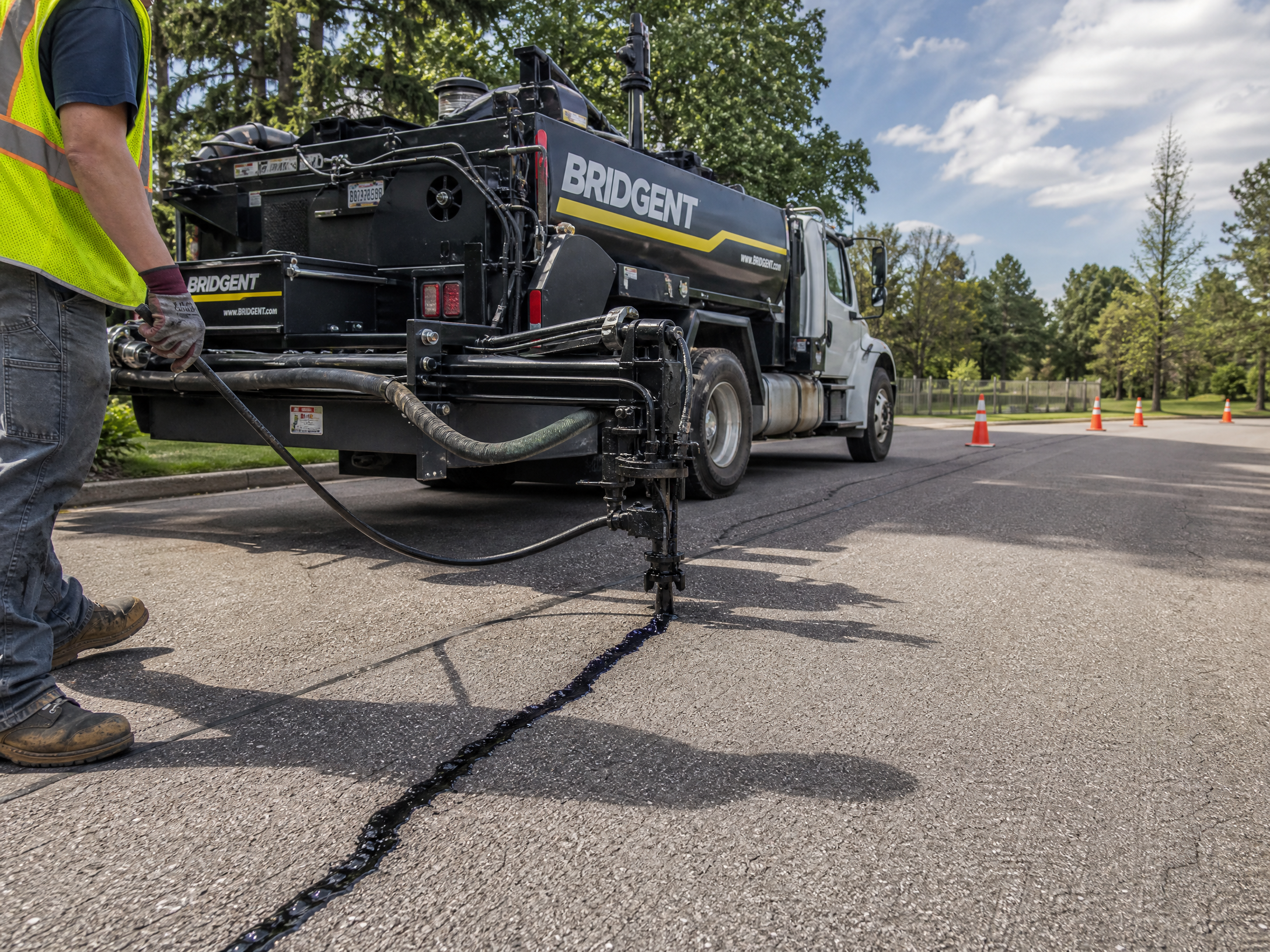
The primary equipment required for applying bitumen emulsion is a standard distributor truck. These trucks are equipped with a heated tank, a pump, and a spray bar that ensures uniform application across the road surface. The spray bar allows for precise control over the application rate. For smaller areas or spot treatments, a pressure sprayer or even manual application can be used, though uniformity may be compromised.
Step-by-Step Application Process
1. Surface Preparation: The road surface should be free of large debris, potholes, and excessive loose material. Light blading or sweeping may be necessary to create a relatively smooth and uniform surface. 2. Pre-wetting (Optional but Recommended): In very dry conditions, a light application of water before the emulsion can help improve penetration and prevent premature breaking of the emulsion. 3. Emulsion Application: The diluted bitumen emulsion is sprayed onto the road surface using the distributor truck. Application rates typically range from 0.5 to 1.5 liters per square meter (L/m²) of diluted emulsion, depending on the dilution ratio and desired effect. Multiple light applications are often more effective than a single heavy application, allowing for better penetration and curing. 4. Curing: After application, the emulsion needs time to cure, allowing the water to evaporate and the bitumen to bind the particles. This process can take several hours to a few days, depending on temperature, humidity, and air circulation. Traffic should be restricted or managed during the curing period to prevent disruption of the treated surface.
Effectiveness and Duration
Bitumen emulsion for dust suppression offers significant and long-lasting effectiveness compared to traditional methods.
Dust Reduction
Studies and field observations consistently show that properly applied bitumen emulsion can reduce airborne dust by 80% to 95%. This dramatic reduction significantly improves air quality, visibility, and safety for road users and adjacent communities.
Duration of Effectiveness
The effectiveness of a single application typically lasts between 6 to 18 months, depending on factors such as traffic volume, weather conditions (rainfall, temperature extremes), soil type, and initial application rate. In areas with moderate traffic and favorable weather, the treatment can last well over a year, providing substantial cost savings in maintenance.
Cost Comparison with Other Dust Suppressants
When evaluating dust suppression solutions, a comprehensive cost analysis is essential. While the initial cost of bitumen emulsion might seem higher than simple watering, its extended effectiveness leads to significant long-term savings.
Common Dust Suppressants and Their Costs
| Dust Suppressant | Initial Cost (Relative) | Reapplication Frequency | Effectiveness Duration | Long-term Cost (Relative) | | :--------------- | :---------------------- | :---------------------- | :--------------------- | :------------------------ | | Water | Low | Daily/Weekly | Hours/Days | Very High | | Calcium Chloride | Medium | Monthly/Quarterly | Weeks/Months | High | | Magnesium Chloride | Medium | Monthly/Quarterly | Weeks/Months | High | | Lignosulfonates | Medium | Quarterly | 3-6 Months | Medium | | Bitumen Emulsion | Medium-High | Annually/Bi-annually | 6-18 Months | Low-Medium |
*Note: Costs are relative and can vary significantly based on regional pricing, transportation, and application specifics.*
Bitumen emulsion, despite a potentially higher upfront material cost, drastically reduces the frequency of reapplication. This translates into lower labor, equipment, and water consumption costs over time. For example, a single application of bitumen emulsion can replace hundreds of watering cycles, making it a far more economical choice for sustained dust control. Bridgent Technology offers cost-effective emulsion solutions tailored to project budgets.
Environmental Benefits
Beyond its technical and economic advantages, bitumen emulsion offers notable environmental benefits. It reduces water consumption significantly compared to watering, conserving a precious resource. Modern emulsions are formulated to be non-toxic and environmentally safe, minimizing ecological impact. By stabilizing the road surface, it also reduces erosion and sediment runoff into waterways.
Conclusion and Key Takeaways
Bitumen emulsion stands out as a superior solution for dust suppression on unpaved roads, offering a blend of effectiveness, durability, and environmental responsibility. Its ability to bind road surface particles provides long-lasting dust control, enhancing safety, improving air quality, and reducing maintenance burdens. For road engineers and procurement managers seeking sustainable and cost-efficient dust management, bitumen emulsion, particularly slow-setting anionic types, applied correctly with standard distributor trucks, represents a strategic investment.
Key Takeaways:
* Bitumen emulsion effectively binds road particles, significantly reducing dust on unpaved roads. * Slow-setting anionic emulsions are ideal for deep penetration and optimal binding. * Standard distributor trucks are the primary equipment for efficient and uniform application. * Effectiveness typically lasts 6-18 months, offering substantial long-term cost savings over traditional methods. * Consider Bridgent Technology for high-quality bitumen emulsion products and technical support.
Discuss Your Project
Contact Bridgent for equipment specifications and a project-specific quotation.